
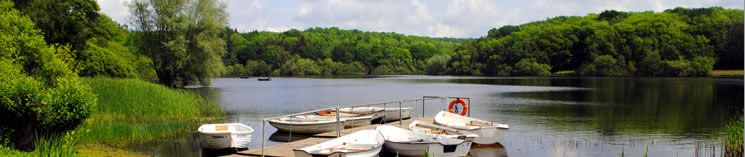

I've lost track of the number of visitors to Powdermill whose conversation included, "I love visiting this place even when I don't catch anything. Such a beautiful location."
I also understand that more than one angler's ashes have been scattered across Powdermill waters. Why? Presumably a final farewell to beauty, an incorruptible innocence they once enjoyed.
Beauty is the connection. It's a bait, a fly if you like to catch and draw us into wonders that have remained unrealised. Visible beauty, in nature, character, children and art, can soothe and pacify. It pours cream on shattered nerves and diminishes the weight of dark moods. Perceived beauty nudges anglers to idle away summer hours outside of the Powdermill fishing hut; sipping coffee, exchanging conversation and "just looking!" Incidentally, I've noticed on the east side of the lake that some deceased person has bequeathed a wooden bench to Hastings Fly Fishers Club. No doubt in memory of idyllic days of woods, water and kindly Powdermill summers.
Beauty wields strange and pleasant influences on sensitive, open-minded people. Unfortunately, it ebbs and flows like ocean tides. One day you feel 'it' the next you don't. That's the nature of beauty or at least its influence on us. Independent of sickness and health, happiness and grief, beauty is allusive and unpredictable in its visitations. I'm sure you know what I mean. One moment it feels impossible to be thrilled about anything, the next we inwardly sing at beauty that's worth displaying on a mantelpiece. At some time or another we have all sensed attractions to surrounding sights and sounds. Men who don't like landscapes are rare. Men who fail to respond to a beautiful woman are even rarer.
Our perception of beauty contradicts all material laws. It comes and goes with a whimsical determination of its own. As I earlier remarked, one day we were touched by it, another day we couldn't see it even though it stared us in the face. My point is, when we become aware of something beautiful we must not constrain its unsought enjoyment. Thankful when it comes and acceptance when it withdraws. Importantly, as with all pleasures and interests, if appreciation of nature cannot be acquired at whim, it's certainly assisted by regular practises of looking, observing and inwardly interpreting what it is saying to us.
Fly fishermen have an advantage over many people; we have priceless opportunities to be alone. Time to think, feel and savour the countryside beauty around us. While not fleeing the obligations of society, for the present moment we are not dependent on them. Thoughtful opportunities are presenting themselves to watch swallows chasing across glittering water, primroses running down banks, the architecture of trees and that skein of ducks flying into crimson sunsets. Crazily, I love to sprawl on the grass just to watch clouds embedded in that childhood blue.
Annually, we are privileged to be surrounded by the cycle of the seasons. The girlishness of Spring, sensuality of summer, secrets of autumn and severity of winter. With quiet perceptiveness and openness of eye, a sense of wonder can grip us. A mysterious depth of satisfaction. A yearning for we know not that is evoked by beauty that captivates us. Simple things observed a thousand times suddenly cast spells on our inner spirit. Something new that is sweet and other-worldly beckons for our attention. There's nothing religious about this. Anybody can experience it. Atheists, religious believers and non-believers alike are tapping into sensed wonders and felt beauty that can never to be defined in precise terms.
There is an enviable influence behind all beauty that we see. Behind the wind that we hear, the wildlife we observe, the sunsets we admire. Sights and sounds become necessary sustenance feeding our deepest spirit even though we weren't aware that we needed anything. B.B the nature writer made the brilliantly 'mad' suggestion that, "Once we are begging to seek and search it may even be that in some measure, if not full measure, health will return to us. Nature has cures which are unknown even to the cleverest doctors, and the power of the will is a potent power which sometimes fills us with awe and wonder.". In other words, nature becomes a gentle emotional healer.
Another 'mad' man, William Blake, in one of his wild, half-inspired utterances, went even further. He announced that a person's hope of immortality depended not upon virtuous behaviour but upon wise perception.
A great contrast to recorded events in Yung Chang's best selling book, "Wild Swans." Yung describes the terrible suffering that she and her parents experienced during the Chinese leadership of Mao Tse Tung. The final act of communist lunacy occurred when an order was received that flowers and grass were a distraction to belief. They were not useful to a communist system. Yung Chang and her friends were forced to pull up all the grass and flowers from the school garden.
As well as blissful days at Powdermill lake, maybe we all, quite unknowingly during our fishing, stand (or sit) on the verge of grasping nature's momentous secrets. By simply looking, contemplating, drinking-in and staying curiously childlike about natural beauty around us, enthralling things could gather and grow inside us. It's worth an attempt at schooling ourselves. On the other hand, maybe I'm a silly old fool!
1. "Letters from Compton Deverell." by B.B.
PHIL STREETER
I also understand that more than one angler's ashes have been scattered across Powdermill waters. Why? Presumably a final farewell to beauty, an incorruptible innocence they once enjoyed.
Beauty is the connection. It's a bait, a fly if you like to catch and draw us into wonders that have remained unrealised. Visible beauty, in nature, character, children and art, can soothe and pacify. It pours cream on shattered nerves and diminishes the weight of dark moods. Perceived beauty nudges anglers to idle away summer hours outside of the Powdermill fishing hut; sipping coffee, exchanging conversation and "just looking!" Incidentally, I've noticed on the east side of the lake that some deceased person has bequeathed a wooden bench to Hastings Fly Fishers Club. No doubt in memory of idyllic days of woods, water and kindly Powdermill summers.
Beauty wields strange and pleasant influences on sensitive, open-minded people. Unfortunately, it ebbs and flows like ocean tides. One day you feel 'it' the next you don't. That's the nature of beauty or at least its influence on us. Independent of sickness and health, happiness and grief, beauty is allusive and unpredictable in its visitations. I'm sure you know what I mean. One moment it feels impossible to be thrilled about anything, the next we inwardly sing at beauty that's worth displaying on a mantelpiece. At some time or another we have all sensed attractions to surrounding sights and sounds. Men who don't like landscapes are rare. Men who fail to respond to a beautiful woman are even rarer.
Our perception of beauty contradicts all material laws. It comes and goes with a whimsical determination of its own. As I earlier remarked, one day we were touched by it, another day we couldn't see it even though it stared us in the face. My point is, when we become aware of something beautiful we must not constrain its unsought enjoyment. Thankful when it comes and acceptance when it withdraws. Importantly, as with all pleasures and interests, if appreciation of nature cannot be acquired at whim, it's certainly assisted by regular practises of looking, observing and inwardly interpreting what it is saying to us.
Fly fishermen have an advantage over many people; we have priceless opportunities to be alone. Time to think, feel and savour the countryside beauty around us. While not fleeing the obligations of society, for the present moment we are not dependent on them. Thoughtful opportunities are presenting themselves to watch swallows chasing across glittering water, primroses running down banks, the architecture of trees and that skein of ducks flying into crimson sunsets. Crazily, I love to sprawl on the grass just to watch clouds embedded in that childhood blue.
Annually, we are privileged to be surrounded by the cycle of the seasons. The girlishness of Spring, sensuality of summer, secrets of autumn and severity of winter. With quiet perceptiveness and openness of eye, a sense of wonder can grip us. A mysterious depth of satisfaction. A yearning for we know not that is evoked by beauty that captivates us. Simple things observed a thousand times suddenly cast spells on our inner spirit. Something new that is sweet and other-worldly beckons for our attention. There's nothing religious about this. Anybody can experience it. Atheists, religious believers and non-believers alike are tapping into sensed wonders and felt beauty that can never to be defined in precise terms.
There is an enviable influence behind all beauty that we see. Behind the wind that we hear, the wildlife we observe, the sunsets we admire. Sights and sounds become necessary sustenance feeding our deepest spirit even though we weren't aware that we needed anything. B.B the nature writer made the brilliantly 'mad' suggestion that, "Once we are begging to seek and search it may even be that in some measure, if not full measure, health will return to us. Nature has cures which are unknown even to the cleverest doctors, and the power of the will is a potent power which sometimes fills us with awe and wonder.". In other words, nature becomes a gentle emotional healer.
Another 'mad' man, William Blake, in one of his wild, half-inspired utterances, went even further. He announced that a person's hope of immortality depended not upon virtuous behaviour but upon wise perception.
A great contrast to recorded events in Yung Chang's best selling book, "Wild Swans." Yung describes the terrible suffering that she and her parents experienced during the Chinese leadership of Mao Tse Tung. The final act of communist lunacy occurred when an order was received that flowers and grass were a distraction to belief. They were not useful to a communist system. Yung Chang and her friends were forced to pull up all the grass and flowers from the school garden.
As well as blissful days at Powdermill lake, maybe we all, quite unknowingly during our fishing, stand (or sit) on the verge of grasping nature's momentous secrets. By simply looking, contemplating, drinking-in and staying curiously childlike about natural beauty around us, enthralling things could gather and grow inside us. It's worth an attempt at schooling ourselves. On the other hand, maybe I'm a silly old fool!
1. "Letters from Compton Deverell." by B.B.
PHIL STREETER