
| FLORA AND FAUNA |
Mayfly at Powdermill Reservoir
Powdermill Reservoir has four mayfly species:
- Drake Mackerel Mayfly, Ephemera vulgata
- Siphlonurus aestivalis, a newly discovered summer mayfly species
- Pond Olive, Cloeon dipterum
- Anglers Curse, Caenis horaria
Drake Mackerel Mayfly
Ephemera vulgata is the crowning glory of Powdermill. The massive hatches of this mayfly give unparalleled fly fishing sport at the reservoir from the end of April through to June.
The species is a large fly and a close relation of Ephemera danica, ‘the’ mayfly of the Hampshire chalk streams. The nymphs of both take two years to grow to adults.
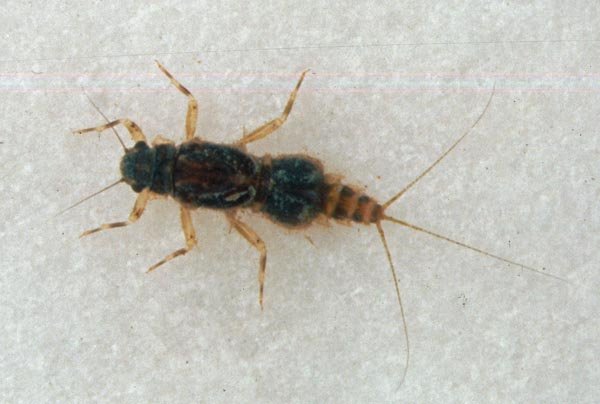
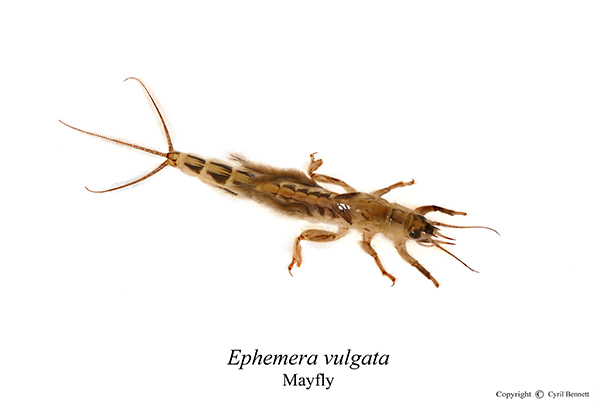
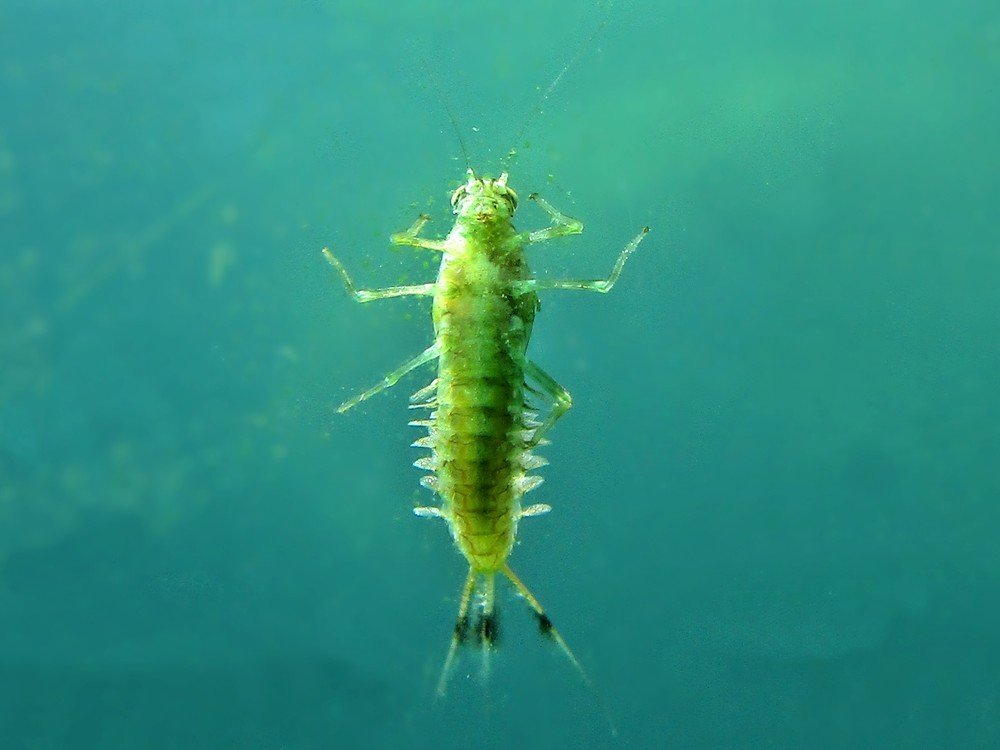
The nymphs use a couple of tusks on the front of their head to make a burrow in which they sit on the bottom of the lake or river. The tusks can be seen on the attached photo, as well as the feathery gills which the nymphs use to force water through the burrow in part to feed on the organic debris it contains.
After two years the nymphs rise to the surface of the reservoir and hatch as duns (sub-imagos). The duns fly to nearby bushes and trees where they hang upside down as the final stage—the spinner (imago)—emerges from the dun.
Male spinners gather in large swarms in the afternoon or early evening. The swarms dance up and down with the males’ extremely long tails stabilizing their flight. Female spinners attracted by the dance fly into the swarm. Males use their very long front legs to grab them and mate. Females then return to the reservoir to lay eggs, completing the life cycle.
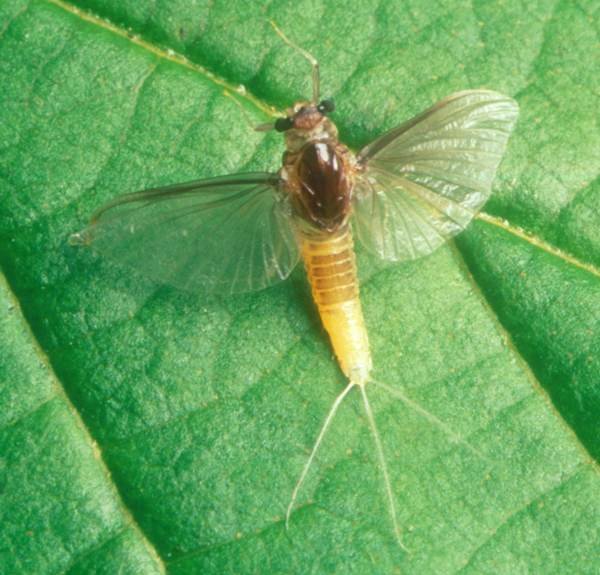
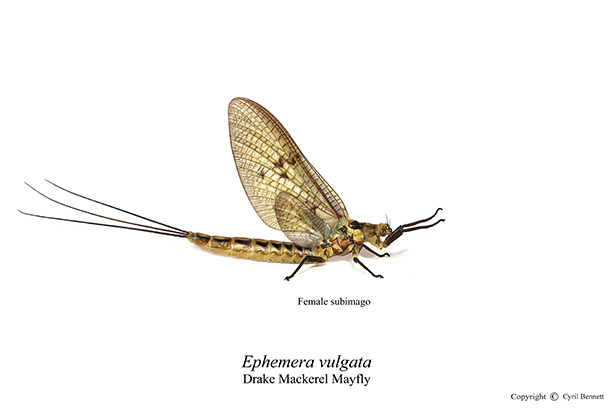
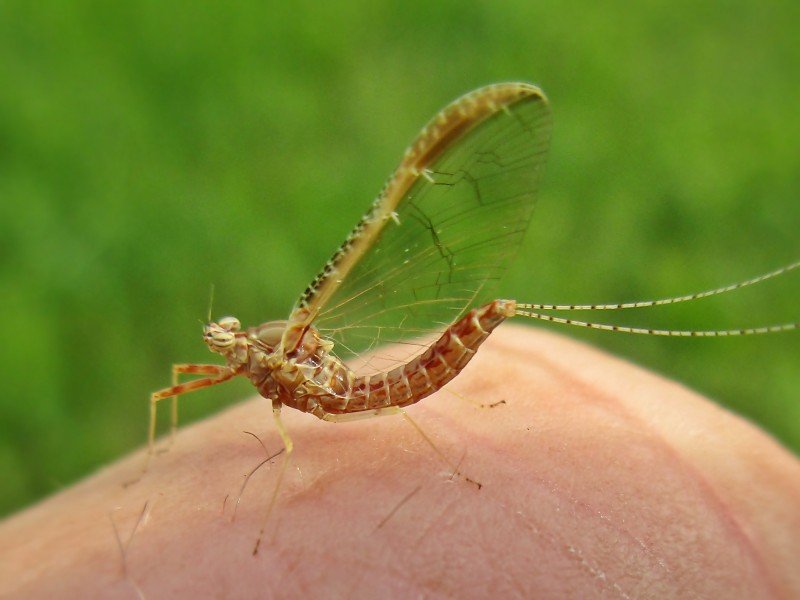
As you can see from the accompanying photo, the adult Drake Mackerel Mayfly has three tails, which is an important distinguishing feature from the other large mayfly present at the reservoir: the summer mayfly Siphlonurus aestivalis, which has two.
Trout feed on both the nymphs of vulgata and the adults. With the adults, trout mostly rise to the duns (sub-imagos) as the flies hatch from the surface of the reservoir, but they will also take the female spinners (imagos) as they return to the reservoir to lay eggs.
Siphlonurus aestivalis – The Early Summer Mayfly
Siphlonurus aestivalis is a new addition to the British list of mayfly species. It is a large Summer Mayfly and has been known to exist in mainland Europe for over a century, but until 2019 it was unrecorded in the British Isles. In that year, a couple of nymphs were found in the Highlands of Scotland. Subsequent work, including genetic analysis of specimens by the Natural History Museum in London, confirmed the presence of aestivalis at three other locations in Britain, including Darwell and Powdermill Reservoirs, both of which have large populations of the mayfly.
As aestivalis was previously unknown in Britain, it did not have a common name. In discussion with Craig Macadam, the country’s leading expert on mayflies, it was decided to call it the ‘Early Summer Mayfly’ because of the four Summer Mayflies on the British list, aestivalis hatches earliest in the year.
Powdermill then is blessed with not one but two large mayfly species: Ephemera vulgata (the Drake Mackerel Mayfly) and Siphlonurus aestivalis (the Early Summer Mayfly). At a quick glance they may appear similar, but there are significant differences between their preferred habitat, life cycle, and anatomy.
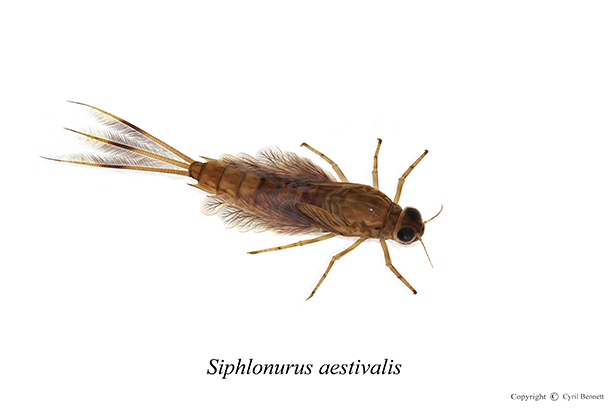
Drake Mackerel Mayfly nymphs have feather-like gills on the back of their body and live in a small tunnel they make in the bottom of the reservoir, whereas aestivalis has plate-like gills which stick out from the side of the body and lives amongst underwater vegetation and weed.
Vulgata nymphs take two years to develop into adult flies, but aestivalis takes only six months. Despite the time difference, both species’ adults are large mayflies.
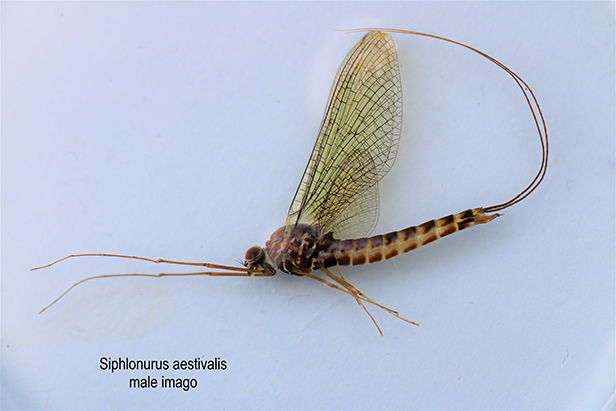
The coloration of both species' adults is similar and both have large hindwings. There is one obvious difference however: the Early Summer Mayfly has two tails, whereas the Drake Mackerel Mayfly has three.
The hatch periods of the species at Powdermill overlap. Possibly aestivalis starts a little earlier, but it is rapidly overwhelmed by the huge number of vulgata at the reservoir. There are large numbers of the Early Summer Mayfly at Powdermill, but the numbers of Drake Mackerel Mayfly are biblical!
The question comes to mind as to why this Summer Mayfly was not noticed previously by Hastings Flyfishers. The answer is it was, at least at Darwell, where it was called the Summer Dun. In 1970, none other than Richard Walker (of Clarissa the Carp fame) actually lodged specimens at the Natural History Museum, albeit misidentified. Clearly then, the Early Summer Mayfly is not a recent arrival at Darwell or Powdermill. It has probably been present ever since the reservoirs were formed.
Siphlonurus aestivalis must be a significant food resource for the trout and indeed the Rudd at Powdermill, but how important it is to fly fishing remains to be established. I suspect it is an interesting addition to the club’s fauna, but fishing-wise, the massive population of Ephemera vulgata is the vital element. Despite voicing this thought, I have tasked an expert fly-tying friend of mine, Peter Hayes, to tie up some dry fly representations of the Early Summer Mayfly and will use them at the first sign of the natural fly at the reservoir. I will let the club know how I get on.
Pond Olive – Cloeon dipterum
Cloeon dipterum, commonly known as the Pond Olive, is one of the most widely distributed and ecologically versatile mayflies found in stillwater environments across the UK. At Powdermill Reservoir, it provides a steady and reliable food source for trout throughout the spring, summer, and early autumn months.
Unlike the two-year life cycle of the Drake Mackerel Mayfly, the Pond Olive is capable of generating multiple generations in a single season. The nymphs belong to the "swimming" category—they are nimble, agile swimmers that inhabit the margins, silt beds, and underwater weed banks of the reservoir. A unique physiological feature of Cloeon dipterum is ovoviviparity; the female imago carries fertilized eggs within her body for up to two weeks until they are fully developed, hatching almost instantly upon touching the surface of the reservoir.
Hatching occurs continuously from May right through to October. The duns emerge quickly on the water surface and take flight to nearby shoreline foliage. Adult flies feature distinctive brown-patterned wing margins in females and possess two long, slender tails. A defining anatomical characteristic of the genus Cloeon is the complete absence of hindwings.
Trout at Powdermill feed enthusiastically on both the agile nymphs darting through weed beds and the emerging duns resting on the surface film. Artificial imitations such as size 14–16 Rough Olives, Pheasant Tail Nymphs, and CDC Olive Duns prove exceptionally effective when matching hatches of the Pond Olive.
Anglers Curse – Caenis horaria
Caenis horaria, universally known to fly fishers as the "Anglers Curse", is one of the smallest mayfly species inhabiting Powdermill Reservoir. Despite its tiny physical stature—measuring just 3mm to 5mm in length—it produces massive, atmospheric hatches during mid-to-late summer evenings and early mornings.
The nymphs of Caenis horaria are silt-dwellers that burrow into the fine mud and organic debris covering the reservoir bed. They possess specialized cover-like gills that protect their respiratory apparatus from becoming clogged with fine sediment. When mature, the nymphs crawl out of the silt and rise to the surface to hatch into adults with incredible speed.
The nickname "Anglers Curse" comes from the notorious frustration it presents to fly fishers. During peak hatches in July and August, millions of tiny white-winged duns and spinners blanket the calm surface of the reservoir. Trout lock into feeding on these microscopic insects, rising continuously in graceful, subtle head-and-tail rings. Because the sheer density of natural flies on the water is so overwhelming, getting a trout to select an artificial pattern requires ultra-fine tippets, minute fly patterns (sizes 20 to 24), and painstaking accuracy.
Adult Caenis have pale, translucent bodies, large broad forewings, no hindwings, and three long filaments extending from the tail. Mating swarms occur at dawn or dusk, after which millions of spent spinners fall onto the water, offering late-evening and early-morning surface action for the observant angler.